
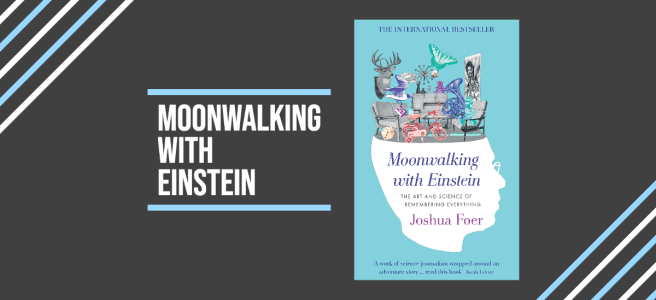
Author: Joshua Foer
Rating: 4/5
Notable Quotes:
…who we are and what we do it is fundamentally a function of what we remember.
Life seems to speed up as we get older because life gets less memorable as we get older.
Memory is like a spiderweb that catches new information. The more it catches, the bigger it grows. And the bigger it grows, the more it catches.
If you want to live a memorable life, you have to be the kind of person who remembers to remember.
Summary (less than 100 words):
This book tells the story of Joshua Foer’s exploration into the world of memory and the art of remembering things. He tells the story of his discovery of the topic and then the story of how, in a year, he went from a novice to winning the American Memory Championship (2006). He goes into detail about the techniques used to enhance his memory, the main one being elaborative encoding, and also includes scientific studies surrounding the topic and fascinating interviews with other memory gurus.
Interesting things you learnt:
- Elaborative encoding: a mnemonic that relates to-be-remembered information to previously existing memories and knowledge. One can make such connections visually, spatially, semantically, or acoustically.
- Trick for remembering names: Always associate the sound of a person’s name with something you can clearly imagine. It’s all about creating a vivid image in your mind that anchors your visual memory of the person’s face to a visual memory connected to the person’s name. When you need to reach back and remember the person’s name at some later date, the image you created will simply pop back into your mind. ““So, hmm you said your name was Josh Foer, eh?” He raised an eyebrow and gave his chin a melodramatic stroke. “Well, I’d imagine you joshing me where we first met, outside the competition hall, and I’d imagine myself breaking into four pieces in response. Four / Foer, get it?””
- The trick to remembering lists of numbers or cards is to use the PAO Mnemonic System. The “Person-Action-Object System” requires you to convert things you need to remember into three sections: A person, an action for the person, and the object which is part of the action. This makes remembering easier as our brain is more capable of remembering such images. More info on this on The Art of Memory website.
- The Major System is one type of PAO. In the Major System, every digit is converted into a consonant. Zero becomes “s” or “z”, and one becomes “d” or “t”. The number, 11 might become ”Titan” and 10 might become “Otis Redding”. 12 might become Tin a Turner. Once you have 100 persons for the numbers 00 to 99, give each person an action and an object. 10 might be Otis Redding → singing-into → a microphone.
- Chunking is a way to decrease the number of items you have to remember by increasing the size of each item.
- According to Ericsson, what we call expertise is really just ” vast amounts of knowledge, pattern-based retrieval, and planning mechanisms acquired over many years of experience in the associated domain. ” In other words, a great memory isn’t just a by-product of expertise; it is the essence of expertise.

 Owen Venter